“Quick-dry” is probably the most-used phrase in travel clothing marketing. It is also one of the vaguest. Every brand claims it, few specify a dry time, and the real-world performance across products with the same label varies by a factor of ten or more. A well-chosen synthetic tee can be dry in forty minutes after a sink wash; a poorly-chosen “quick-dry” shirt can still be damp the next morning.
This guide explains what actually makes fabric dry fast, how to read a label for real drying performance, and what to expect from each common travel fabric so you can plan around it on the road.
The physics of drying
Fabric dries through two mechanisms: evaporation of surface moisture, and transport of internal moisture to the surface where it can evaporate. The speed of both processes depends on how the fabric handles water at a fiber level.
Hydrophobic fibers (water-repelling)
Polyester and nylon are hydrophobic — the fiber surface repels water. Wet a polyester shirt and almost all the water sits between the fibers (in the gaps and on the surface), not inside them. Surface water evaporates quickly because it is directly exposed to air. This is why synthetic athletic shirts feel clammy but dry fast: they are holding water on their surface, not in their fiber structure.
Hydrophilic fibers (water-absorbing)
Cotton, wool, linen, Tencel, and silk are hydrophilic — the fiber itself absorbs water into its internal structure. Wet a cotton shirt and water soaks into each individual fiber, not just into the gaps between them. To dry the shirt, that internal moisture has to migrate back out of each fiber before it can evaporate. That takes time.
Different hydrophilic fibers hold different amounts of water and release it at different rates:
- Cotton — absorbs up to 25% of its weight in water, releases slowly. The worst combination for drying speed.
- Linen — absorbs up to 20%, releases moderately fast due to the stiff fiber structure.
- Wool (merino) — absorbs up to 30% (more than cotton), but releases moisture steadily and feels dry to the touch even while holding substantial water.
- Tencel/lyocell — absorbs up to 15%, releases faster than cotton.
- Silk — absorbs up to 30%, releases slowly.
Wicking — moving water along the fabric
Wicking is the mechanical transport of water along fibers via capillary action. It is distinct from absorption. A wicking fabric moves sweat or sink-wash water along the fabric surface to where it can evaporate, rather than holding it in place.
All synthetic performance fabrics wick. Many are engineered with specific cross-sectional shapes (four-channel or six-channel fiber profiles) that maximize capillary action. Natural fibers wick less effectively because absorption competes with capillary transport.
The practical result: a well-designed polyester tee wicks sweat from skin to fabric surface and then evaporates it quickly, drying in under an hour. A cotton tee absorbs the same sweat into the fiber interior and holds it there.
Dry time by fabric category
Realistic dry times for a moderately wet tee (hand-wrung after sink wash) in a typical hotel room (70°F, 50% humidity, minimal airflow):
| Fabric | Dry time |
|---|---|
| 100% polyester performance tee | 45–90 minutes |
| Polyester-elastane blend | 1–2 hours |
| 100% nylon shirt | 1–2 hours |
| Nylon-elastane travel pants | 2–4 hours |
| Merino wool tee (150 gsm) | 4–8 hours |
| Merino-nylon blend tee | 3–6 hours |
| Tencel or Tencel-cotton blend | 4–8 hours |
| Silk base layer | 4–8 hours |
| Linen shirt | 4–8 hours |
| Cotton tee | 8–24 hours |
| Cotton denim | 12–48 hours |
Conditions change these dramatically:
- Sunny window with airflow: cuts dry time roughly in half.
- Humid bathroom with no airflow: doubles or triples dry time.
- Overnight with a fan pointed at the garment: polyester is dry by morning regardless of starting wetness; cotton is not.
Fabric construction affects dry speed
Fiber content sets the ceiling on dry speed; construction determines how close you get to it.
Weight (gsm)
Heavier fabric holds more water and dries slower, even within the same fiber type. A 120-gsm polyester running shirt dries twice as fast as a 200-gsm polyester polo shirt. This is why trail-runner ultralight shirts dominate “fastest-drying” conversations — they have the minimum amount of fiber needed to cover the body.
Weave vs knit
Knitted fabrics (t-shirts, polos) dry faster than woven fabrics (button-downs, pants) of the same fiber and weight, because the looser structure lets air move through more easily.
Mesh panels and open weaves
Tech shirts with mesh side panels dry faster through those panels. This is a meaningful contributor to dry time in hot-weather shirts where partial mesh construction is common.
Fiber cross-section
Engineered synthetics with channel-grooved fibers (Coolmax, many of Patagonia’s Capilene fabrics, Columbia Omni-Wick) move surface moisture faster than round-cross-section synthetics. This is a real performance advantage that shows up in side-by-side testing, though the difference is smaller than fiber content and fabric weight.
DWR coatings and water repellency
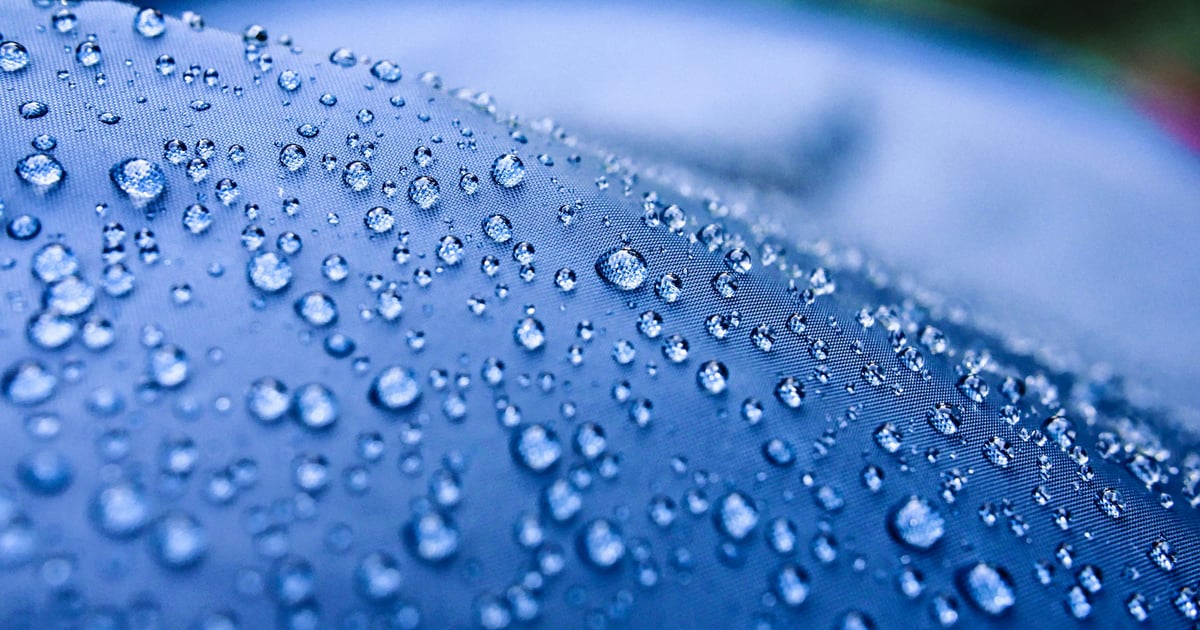
DWR (Durable Water Repellent) coatings add an extra dimension to the “quick-dry” conversation. DWR is a chemical treatment applied to fabric that makes water bead and roll off rather than soak in. Most technical rain shells and many travel pants are DWR-treated.
What DWR does for dry time
A DWR-treated garment does not get wet in the first place under light rain or splashing — the water never soaks into the fabric, so there is nothing to dry. This is the main value of DWR for travel: your rain shell, after a light shower, is dry within minutes because it never absorbed the water.
What DWR does not do
Under sustained heavy rain, the DWR is overwhelmed and the fabric wets through. Once wet, the fabric’s underlying fiber content determines dry speed — a DWR-treated nylon shell still dries much faster than a DWR-treated cotton canvas jacket. DWR delays the point at which the fabric gets wet; it does not speed up drying after that point.
DWR degrades
DWR wears off with washing, abrasion, and UV exposure. Most DWR treatments are at about 50% performance after 20 washes and need to be reapplied with a spray-on treatment (Nikwax TX.Direct or similar) to restore performance. A three-year-old rain shell that soaks through immediately almost always needs DWR re-treatment, not replacement. For current picks on shells that balance water repellency with quick drying, see our best packable rain jackets roundup.
Reading the label for quick-dry claims
The word “quick-dry” on a tag means essentially nothing by itself. Here is what actually matters:
- Fiber content. 100% polyester or nylon is quick-dry by definition. Cotton in any proportion slows dry time meaningfully — a 60/40 poly-cotton blend is roughly twice as slow as 100% polyester.
- Fabric weight. Lighter is faster. If you can find a gsm number, lower is faster at the same fiber content.
- Brand-specific technology names. Coolmax, Polartec Delta, Patagonia Capilene, Columbia Omni-Wick, Outdoor Research AirVent — these are proprietary quick-dry fabric systems that consistently outperform generic synthetics. The names are not magic marketing; they refer to specific engineered fabrics.
- Construction details. Mesh panels, lightweight knits, minimal seams all contribute.
- DWR labeling on outerwear. “DWR treated,” “water repellent,” “Omni-Shield” all indicate the garment sheds light moisture instead of absorbing it.
Marketing words that mean little
- “Quick-dry technology” (no brand or fabric name attached)
- “Moisture-wicking” (true of all synthetics; generic)
- “Breathable” (unrelated to drying, though often bundled)
- “Sweat-activated” (marketing prose)
Practical dry-time strategies for travelers
Knowing the physics is useful; applying it to how you actually wash and pack clothing in hotels matters more. A few real-world patterns:
The sink-wash, roll-dry method
After washing a synthetic tee in a sink, lay it flat on a dry towel, roll the towel up tightly with the shirt inside, and twist the roll. The towel absorbs most of the water in about thirty seconds. A polyester shirt treated this way is often dry in twenty to thirty minutes hung in a room with airflow. This is the fastest reliable way to dry travel clothing without a dryer.
Bathroom overnight (with fan)
Hang the wet garment in the bathroom with the fan running. Even without a fan, the airflow from an HVAC system usually dries a synthetic tee by morning. A cotton tee is often still damp.
The two-day layered rotation
On trips where you wash nightly, you need either fast-drying fabrics (synthetics, merino-synthetic blends) or enough rotation that yesterday’s still-drying garment is not needed today. Pure merino and cotton frequently need a full rest day.
Fabric choice by activity
- High-sweat activity days (hiking, city walking in heat, active travel) — 100% polyester or nylon-based tops dry between activities and overnight; cotton stays damp and miserable.
- Low-sweat business days — merino or merino blends are fine; dry time is less critical because the garment is not soaking wet.
- Wet-weather days — DWR-treated nylon shell stays dry on the outside; under-layers should be quick-drying synthetic or merino, not cotton.
What to skip when shopping for quick-dry
A checklist of things that do not deliver on the quick-dry promise despite marketing:
- 100% cotton anything labeled “quick-dry” — the marketing language cannot change the fiber properties. Cotton dries slowly.
- Poly-cotton blends under 50% polyester — not enough polyester to meaningfully accelerate drying over straight cotton.
- Heavy-gsm “technical” fabrics — a 250-gsm polyester shirt dries slower than a 150-gsm polyester shirt; if both claim “quick-dry,” the weight matters more than the claim.
- Waterproof rain gear without DWR mention — “waterproof” and “dries quickly” are different claims. A rubber-coated jacket keeps water out but dries slowly once wet because water gets trapped inside.
- Bamboo-cotton or hemp-cotton blends — regardless of the marketing, any significant cotton content in the blend controls dry time.
Realistic expectations
A synthetic travel tee washed in a hotel sink at 8pm is reliably dry by 8am. A merino tee washed at 8pm is reliably dry by mid-morning. A cotton tee washed at 8pm is probably still damp twenty-four hours later.
Plan wardrobes accordingly. For one-bag travelers who wash every one or two days, synthetics and merino are the realistic choices. For travelers who do weekly laundry and pack more clothes, cotton is fine as long as you are not counting on quick-turnaround drying.
For a practical fabric-by-fabric comparison, see our travel fabrics 101 guide and the merino vs synthetic head-to-head. Our sink-washing guide gets into the mechanics of washing in limited space. Roundups of specific quick-dry travel shirts and travel pants cover current picks.
FAQ
What is the single fastest-drying travel fabric?
Lightweight 100% polyester with a channel-grooved fiber engineering (Coolmax, Polartec Delta, Capilene) is the fastest-drying common travel fabric. A 120-gsm polyester performance tee in this category dries in about 30 minutes after a moderate wash, in a typical hotel room.
Does merino really not qualify as quick-dry?
Merino is in the middle of the dry-time range. It dries slower than synthetics (typically 4 to 8 hours for a tee) but feels dry against skin even while holding significant water, which is the main reason it works well for travel. If strict dry speed is the priority — say, you need the shirt washed tonight and dry for tomorrow morning in a humid climate — synthetic beats merino. For most other travel situations, merino’s dry behavior is adequate.
Do DWR sprays really restore water repellency?
Yes, for a while. A good DWR refresher (Nikwax TX.Direct, Grangers Performance Repel Plus, Revivex) applied to a clean rain shell restores most of the original water-beading performance for another 15–25 washes. The restoration degrades over time and the treatment becomes less effective each time you reapply. After five to ten years of heavy use, the fabric itself wears out and no amount of DWR helps.
Why does my “quick-dry” shirt take all night to dry?
Most likely because it is a blend with significant cotton or Tencel content, or because it is a heavy-weight fabric, or because the hotel room has high humidity and no airflow. Check the fiber content tag — the first word determines the behavior. “60% cotton / 40% polyester” is not quick-dry in any meaningful sense regardless of what the hang-tag says.
Should I pick quick-dry fabrics for everyday travel, or only for active travel?
Quick-dry matters more than most travelers expect. Rain, spilled coffee, unexpected sweating, needing to wash a garment overnight — all happen on regular city travel, not just on hiking trips. A travel wardrobe built mostly on synthetic and merino fabrics is more forgiving across unexpected situations than a cotton-dominant wardrobe, even for people who would describe their trips as “non-athletic.”